Topological Structure Learning Should Be A Research Priority for LLM-Based Multi-Agent Systems
Jul 4, 2025·, ,,,,,,,,·
1 min read
,,,,,,,,·
1 min read
Jiaxi Yang
Mengqi Zhang
Yiqiao Jin
Hao Chen
Qingsong Wen
Lu Lin
Yi He
Srijan Kumar
Weijie Xu
James Evans
Jindong Wang
Abstract
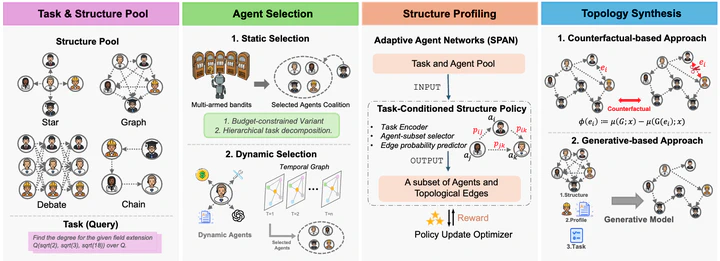
Large Language Model-based Multi-Agent Systems (MASs) have emerged as a powerful paradigm for tackling complex tasks through collaborative intelligence. Nevertheless, the question of how agents should be structurally organized for optimal cooperation remains largely unexplored. In this position paper, we aim to gently redirect the focus of the MAS research community toward this critical dimension: develop topology-aware MASs for specific tasks. Specifically, the system consists of three core components - agents, communication links, and communication patterns - that collectively shape its coordination performance and efficiency. To this end, we introduce a systematic, three-stage framework: agent selection, structure profiling, and topology synthesis. Each stage would trigger new research opportunities in areas such as language models, reinforcement learning, graph learning, and generative modeling; together, they could unleash the full potential of MASs in complicated real-world applications. Then, we discuss the potential challenges and opportunities in the evaluation of multiple systems. We hope our perspective and framework can offer critical new insights in the era of agentic AI.
Type
Publication
arXiv preprint arXiv:2505.22467
Abstract
Large Language Model-based Multi-Agent Systems (MASs) have emerged as a powerful paradigm for tackling complex tasks through collaborative intelligence. Nevertheless, the question of how agents should be structurally organized for optimal cooperation remains largely unexplored. In this position paper, we aim to gently redirect the focus of the MAS research community toward this critical dimension: develop topology-aware MASs for specific tasks. The system consists of three core components — agents, communication links, and communication patterns — that collectively shape its coordination performance and efficiency. We introduce a systematic three-stage framework: agent selection, structure profiling, and topology synthesis.